
Had a call last month with a guy who'd gotten three quotes for what he kept calling "the same app." $12k. $45k. $130k. He wanted me to tell him which
Had a call last month with a guy who’d gotten three quotes for what he kept calling “the same app.” $12k. $45k. $130k. He wanted me to tell him which one was scamming him. Honestly none of them were — they’d quoted three different apps that happened to get described in the same two sentences over the phone.
This happens all the time, by the way. You talk to a mobile app development company, get a number, talk to a second one, get a number nowhere close to it, and your gut says someone’s price gouging. Usually nope. The brief was vague enough that each agency just filled the gaps with their own guess at what you meant.
So let me actually try to unpack this instead of giving you another “it depends” shrug. What’s pushing prices around in 2026, where the money goes once you’ve signed something, how you get a number you can actually trust.
How much does an app cost” isn’t really answerable yet
Cost isn’t something you look up. It’s what falls out the other end after a bunch of smaller decisions get made, and most people ask the price question before any of those decisions exist. A three-screen booking app and a marketplace app with chat, payments, live GPS — both get called “an app.” That’s basically where the confusion starts and never really stops.
Before a quote means anything, somebody needs an actual screen count, not a guess. Does it need a real backend, database, server logic — or can most of it just sit on the phone? iOS, Android, both, native or cross-platform? Anything happening live, chat or location tracking? Who’s building it, freelancer, in-house, agency? Where’s that team sitting, because geography alone can swing the number by double.
Move one of those and the price can jump by tens of thousands. Which is why two “identical” quotes for “the same app” almost never land anywhere close to each other.
Rough numbers for 2026
Take these as a starting point, not a promise — blended averages across North America, Western Europe, South Asia, and every agency prices a little differently anyway.
Simple stuff, barely any backend — a calculator, a habit tracker — usually $8,000 to $25,000. Nothing surprising there.
Mid-complexity: real user accounts, a proper backend, push notifications, maybe payments. A fitness app, a basic delivery app. $30,000 to $80,000 is where this lands, and it’s where most small businesses actually end up sitting.
Then the genuinely complex tier — multi-role platforms, live features, custom backend, a stack of third-party integrations. Fintech, ride-hailing, multi-service apps, that lane. $90,000 to $250,000, climbing higher depending how deep the compliance and security work has to go.
Enterprise platforms — healthcare, banking, government, heavy compliance plus custom AI work or real scale — can blow past $300,000 without much effort. Seen quotes north of seven figures for the right project. Or the wrong one, depending who’s signing the check.
Here’s the part people don’t expect: these ranges haven’t actually moved much since 2023. What’s shifted is where the money goes inside the budget. AI-assisted coding made the repetitive parts — basic forms, CRUD screens, boilerplate — quicker and cheaper than they used to be. Security work and compliance got pricier in the same stretch, mostly because users expect more now, and regulators eventually caught up too.
What actually moves the number
Platform choice matters more than most people assume going in. Native means two separate codebases, iOS and Android — basically two builds wearing one trench coat. Cross-platform tools like Flutter or React Native cover both with one codebase, often cutting cost by 30 to 40 percent. Catch is, if the app leans hard on device hardware or platform-specific animation, native wins anyway, and trying to save money there tends to bite you later.
Design is where budgets get away from people without anyone noticing. Five clean screens, cheap. Twenty custom screens with a full design system and accessibility done right from day one — different cost category entirely. People underestimate this because design doesn’t sound technical the way backend work does. A rushed interface loses users fast after launch though, and fixing that after the fact costs more than doing it right would’ve.
Integrations add up quicker than anyone expects, even small ones. Every connection — payment processor, mapping API, some CRM, an old internal system — adds dev time and, worse, testing time. Payment integration alone, Stripe or a regional gateway, can tack on another three to ten grand once you hit the edge cases nobody mentioned on the kickoff call.
Then there’s who’s actually building it. Freelancers in lower-cost regions, maybe twenty to forty bucks an hour. A boutique agency in the US or UK, more like a hundred to two hundred. Firms that specialize — actually know healthcare compliance, or fintech security, cold — charge above that, and it’s usually worth paying, because a compliance mistake costs way more than the rate difference ever would. No universal right tier here. Cheap teams sometimes do great work. Expensive ones sometimes ship something forgettable. What matters is whether the team’s specific background actually fits what your project needs.
One thing almost nobody budgets for: maintenance. Launch feels like the finish line. It isn’t. Operating systems push updates on their own clock, security patches need applying, users find bugs your QA somehow missed. Plan for something like fifteen to twenty percent of the build cost every year just to keep it running. Skip that part and the app breaks quietly six months in — happens more than people think.
Getting quotes you can actually compare
Want numbers that mean something side by side? Send every team the same exact brief. Core user flow, must-haves versus nice-to-haves, target platforms, known integrations. One page covers it. Don’t let anyone quote off a loose call where the idea got described slightly differently each time — people do that without realizing.
Then ask the question almost everyone skips: what’s actually included in this number, and what’s not? A quote missing QA, app store submission, or the first month of post-launch fixes isn’t 30 percent cheaper than the other guy’s. It’s the same 30 percent, just pushed to later, at a point where there’s a lot less room to push back because you’re already in.
Worth asking too how they handle scope changes, because scope changes. Pretty much always does. Teams with an actual change-request process and fixed rates for extra work spare you the renegotiation mess that tends to show up around month three, give or take.
So what’s the real number
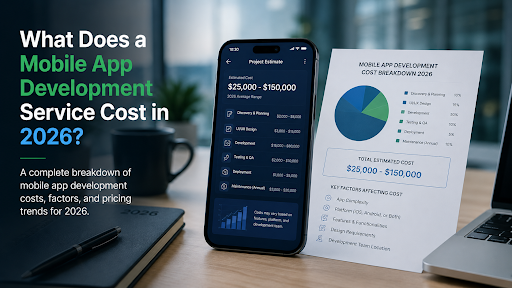
One figure to walk away with: most straightforward business apps launching this year land somewhere around $25,000 to $90,000, full build through launch. Go well below that and it’s probably skipped testing or a template wearing a custom paint job. Go well above it and the team should be able to point at exactly what’s driving the extra cost, not just gesture at “quality” and move on.
Chasing the lowest possible mobile app development cost feels like the obvious move when you’re staring at a spreadsheet of quotes. It’s not actually the smart one. Figuring out what’s driving your specific number is — so the budget lands on stuff that matters, security, a backend that holds up under real traffic, an interface people don’t bounce off of, instead of getting spread thin and even across everything regardless of whether it needs the money. Cheap and worth-it aren’t the same thing. That’s really the whole difference.
