
Applying for a Civil Service job can feel exciting one minute and overwhelming the next. You read the job advert, notice several civil service behavi
Applying for a Civil Service job can feel exciting one minute and overwhelming the next. You read the job advert, notice several civil service behaviours, and suddenly wonder what they actually mean. Are recruiters expecting perfect answers? Do you need years of experience? Or is there a specific way they’re judging your responses?
The good news is that Civil Service recruitment isn’t about catching people out. It’s designed to give every applicant a fair opportunity to demonstrate how they approach situations, solve problems, communicate with others, and make decisions. That’s exactly where behaviours come into play.
Whether you’re applying for your very first Civil Service role or hoping to move into a higher grade, understanding these behaviours can dramatically improve both your application and interview performance. Once you know what assessors are really looking for, writing stronger examples becomes much easier.
Let’s break everything down in a practical, straightforward way.
What Are Civil Service Behaviours?
If you’ve ever completed a job application that asked for examples from your previous work, studies, or volunteering, you’ve already encountered behavioural assessments, even if they weren’t called that.
Within the UK Civil Service, behaviours form part of the Success Profiles recruitment framework. Rather than focusing only on qualifications or technical knowledge, employers also evaluate how you work. This helps recruiters identify candidates who can thrive in real workplace situations.
Instead of asking questions like:
“Are you a good leader?”
they’ll ask something closer to:
“Tell us about a time when you motivated others during a challenging project.”
Your answer provides evidence rather than opinion.
Each behaviour represents a workplace skill that’s valuable across many government departments, including communication, teamwork, leadership, decision-making, and problem-solving. Depending on the role and grade, employers may assess only a few behaviours or several during different stages of recruitment.
Ultimately, the aim is simple: finding people whose working style matches the responsibilities of the role.
Why Civil Service Behaviours Matter During Recruitment
Many candidates spend hours polishing their CV but only a few minutes thinking about behavioural examples. Ironically, those examples often have a much bigger influence on the final decision.
Recruiters use behaviours because they’re more reliable than general statements. Anyone can claim they’re organised or a great communicator. Real examples prove it.
Imagine two applicants.
The first says:
“I’m excellent under pressure.”
The second explains how they managed multiple urgent deadlines, prioritised tasks, coordinated with colleagues, and successfully delivered an important project before the deadline.
Which one feels more convincing?
That’s exactly how assessors think.
Behavioural evidence allows interview panels to compare candidates fairly using consistent scoring criteria. Every answer demonstrates how someone responds to challenges, collaborates with others, manages conflict, and delivers results.
This approach also reduces unconscious bias because decisions rely on observable examples rather than assumptions or personal impressions.
For applicants, that means preparation matters far more than memorising impressive phrases.
Understanding the Success Profiles Framework
One of the biggest misconceptions is that behaviours are the only thing recruiters assess. In reality, they’re just one part of the wider Success Profiles framework.
Depending on the vacancy, employers may also evaluate:
- Behaviours
- Strengths
- Experience
- Technical Skills
- Ability
- Professional Skills
Not every recruitment campaign includes every element. Some entry-level positions focus mainly on behaviours and strengths, while specialist roles may place greater emphasis on technical expertise.
Think of Success Profiles as a complete picture rather than a single test.
Someone might have excellent qualifications but struggle to communicate effectively in a team. Another candidate may have less experience yet consistently demonstrate strong judgement, adaptability, and collaboration.
The framework helps employers balance both technical capability and workplace behaviour, creating a recruitment process that’s designed to identify candidates who can perform successfully over the long term, not just impress during one interview.
The Most Common Civil Service Behaviours You’ll See
Although vacancies vary across departments and grades, several behaviours appear repeatedly throughout Civil Service recruitment.
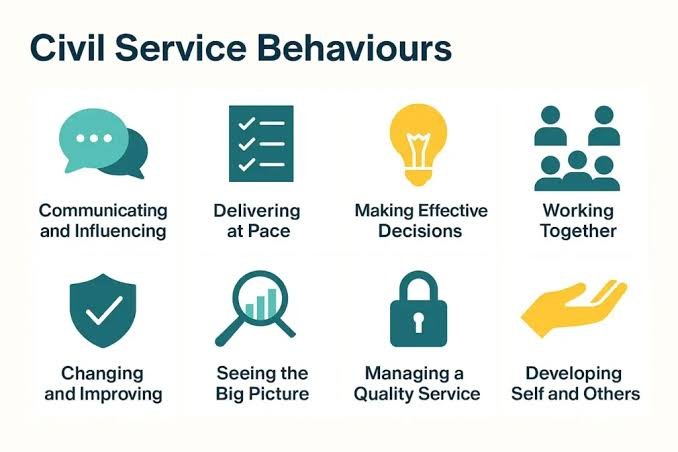
Communicating and Influencing
Strong communication goes beyond speaking confidently. Assessors want evidence that you can explain ideas clearly, listen actively, adapt your message for different audiences, and influence decisions respectfully.
Delivering at Pace
Meeting deadlines while maintaining quality is essential across government roles. Recruiters often look for examples where you’ve balanced competing priorities without sacrificing standards.
Working Together
Few Civil Service jobs happen in isolation. Teamwork, collaboration, supporting colleagues, and resolving disagreements professionally all contribute to this behaviour.
Making Effective Decisions
Employers value people who gather relevant information, assess risks, consider evidence, and make sound, balanced decisions instead of rushing to conclusions.
Seeing the Bigger Picture
This behaviour focuses on understanding how your work contributes to wider organisational objectives, public services, and long-term goals rather than concentrating only on individual tasks.
These behaviours may sound straightforward, but successful candidates always support them with detailed, real-life examples rather than broad descriptions.
Developing Self and Others
One of the most overlooked civil service behaviours is Developing Self and Others. Many candidates assume this only applies to managers, but that’s not the case. Whether you’re applying for an entry-level role or a senior leadership position, recruiters want to see that you’re committed to learning and helping others improve.
Think about the last time you learned a new system at work. Did you keep that knowledge to yourself, or did you share it with your colleagues? Small actions like mentoring a new teammate, creating a quick reference guide, or offering support during training can all demonstrate this behaviour.
A strong example might include:
- Seeking feedback to improve your performance.
- Completing professional development courses.
- Coaching or mentoring a colleague.
- Sharing knowledge to improve team performance.
- Encouraging continuous learning within your workplace.
Remember, development isn’t always about promotions. It’s about showing curiosity, taking initiative, and helping your team become stronger over time.
Managing a Quality Service
Providing a quality service means consistently delivering work that meets the needs of customers, stakeholders, or the public while maintaining high standards.
In Civil Service roles, “customers” may not always be paying clients. They could be members of the public, other government departments, colleagues, or partner organisations. The key is understanding what people need and finding practical ways to deliver it efficiently.
For example, imagine you noticed that customers were repeatedly asking the same questions. Rather than answering them individually every day, you created a simple guidance document that reduced confusion and saved valuable time for both staff and customers.
That’s exactly the kind of initiative recruiters appreciate.
When discussing this behaviour, focus on situations where you:
- Improved a process.
- Increased efficiency.
- Solved recurring problems.
- Maintained accuracy under pressure.
- Received positive feedback from customers or stakeholders.
Real improvements, even small ones, often leave a stronger impression than ambitious claims without evidence.
Changing and Improving
Every workplace evolves. New technology, changing policies, tighter budgets, and shifting priorities all require employees who can adapt without losing focus.
That’s why Changing and Improving is such an important behaviour within the Success Profiles framework.
Recruiters want people who don’t simply accept inefficient processes because “that’s how it’s always been done.”
Instead, they look for candidates who identify opportunities to improve workflows, embrace innovation, and remain flexible when circumstances change.
Perhaps you introduced a new spreadsheet that reduced reporting time. Maybe you suggested a better filing system or helped your team adjust to new software after an organisational change.
The size of the improvement matters far less than your approach.
A great response demonstrates that you:
- Recognised a problem.
- Considered possible solutions.
- Worked collaboratively.
- Implemented positive change.
- Measured or observed the outcome.
Even if the change wasn’t perfect, showing thoughtful problem-solving can score highly.
How to Answer Civil Service Behaviour Questions Using the STAR Method
Knowing the behaviours is only half the battle. The real challenge is presenting your experiences clearly and convincingly during an application or interview.
That’s where the STAR method comes in.
STAR stands for:
Situation
Briefly explain the background. Set the scene without including unnecessary details.
Task
Describe your responsibility or objective.
Action
This is the most important section. Explain exactly what you did, not what your team did.
Use action verbs such as:
- Organised
- Analysed
- Coordinated
- Negotiated
- Improved
- Resolved
- Delivered
- Developed
- Implemented
Result
Finish with measurable outcomes whenever possible.
For example:
- Reduced processing time by 25%.
- Improved customer satisfaction.
- Met an important deadline.
- Saved costs.
- Increased efficiency.
- Received positive stakeholder feedback.
A common mistake is spending too much time explaining the situation while rushing through the action. Assessors award most marks for your contribution, so make that section the star of your answer.
Common Mistakes That Lower Your Score
Even highly qualified applicants can lose valuable marks because of avoidable mistakes.
Here are some of the most common ones.
Being Too Vague
Statements like:
“I’m a good communicator.”
don’t provide evidence.
Instead, explain exactly what happened and what you achieved.
Talking About the Team Instead of Yourself
It’s natural to say “we,” but interview panels need to understand your individual contribution.
Instead of saying:
“We completed the project successfully.”
try:
“I coordinated weekly meetings, monitored deadlines, and resolved communication issues between departments.”
Choosing Weak Examples
Your example doesn’t have to be dramatic, but it should demonstrate genuine responsibility.
Everyday workplace situations often work better than trying to exaggerate a major achievement.
Forgetting the Outcome
Always explain what happened because of your actions.
Without a result, your story feels incomplete.
Not Matching the Behaviour
Read the job advert carefully.
If the behaviour focuses on decision-making, don’t answer with a story that’s mainly about teamwork.
Tailor every example to the behaviour being assessed.
Practical Tips to Prepare for Your Civil Service Interview
Preparation builds confidence, and confidence helps your examples sound more natural.
A few simple habits can make a noticeable difference.
- Read the job description several times and identify every behaviour being assessed.
- Prepare at least two STAR examples for each behaviour.
- Practise saying your answers aloud instead of silently reading them.
- Time yourself so responses stay focused without feeling rushed.
- Keep a notebook of achievements from work, university, volunteering, or personal projects.
- Research the department’s priorities so your answers align with its objectives.
- Think about measurable results you can include in every example.
One useful trick is creating a “story bank.” Instead of memorising answers, collect six to eight strong examples from your experience. Many of them can be adapted to different behaviour questions with only minor adjustments.
This approach feels much more authentic during interviews and helps you avoid sounding rehearsed.
Final Thoughts
Preparing for civil service behaviours can seem intimidating at first, especially if you’ve never applied for a government role before. The encouraging news is that success isn’t reserved for people with decades of experience. Recruiters aren’t looking for perfection, they’re looking for clear evidence of how you think, communicate, collaborate, and solve problems.
The strongest candidates don’t rely on buzzwords or polished clichés. They tell genuine stories that demonstrate real impact, support their answers with specific examples, and use the STAR method to keep their responses structured and easy to follow.
As you prepare your application or interview, focus on understanding each behaviour, selecting relevant experiences, and explaining the difference your actions made. With thoughtful preparation and authentic examples, you’ll be far better equipped to stand out in a competitive recruitment process.
Frequently Asked Questions
1. What are civil service behaviours?
Civil service behaviours are workplace behaviours used within the UK Civil Service Success Profiles framework to assess how candidates perform in different situations. They help recruiters evaluate communication, leadership, teamwork, decision-making, adaptability, and other essential skills.
2. How many civil service behaviours are there?
The Success Profiles framework includes several core behaviours, such as Communicating and Influencing, Delivering at Pace, Working Together, Making Effective Decisions, Seeing the Bigger Picture, Leadership, Developing Self and Others, Managing a Quality Service, and Changing and Improving. The behaviours assessed depend on the specific role and grade.
3. What is the STAR method?
The STAR method is a structured way to answer behavioural questions. It stands for Situation, Task, Action, and Result, helping candidates provide clear, evidence-based examples from their experience.
4. Can I use examples from university or volunteering?
Yes. If you’re early in your career, examples from education, internships, volunteering, sports teams, or community projects can effectively demonstrate Civil Service behaviours, provided they are relevant and clearly explain your personal contribution.
5. How should I prepare for a Civil Service behaviour interview?
Review the behaviours listed in the job advert, prepare multiple STAR examples, practise speaking your answers aloud, focus on measurable outcomes, and tailor your responses to the role. Authentic, well-structured examples are usually more effective than memorised scripts.
