
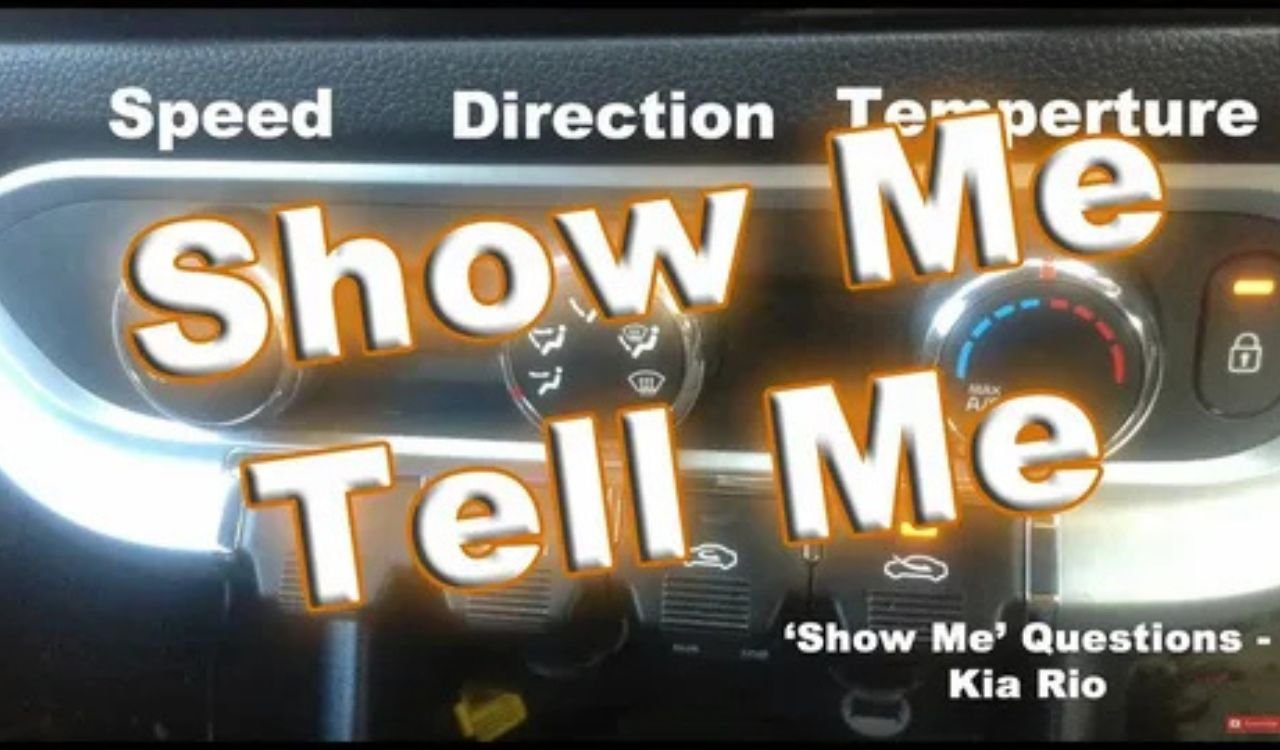
You are sitting in the test car, the examiner has checked your provisional licence, and then comes the question you somehow forgot existed: “Tell me h
You are sitting in the test car, the examiner has checked your provisional licence, and then comes the question you somehow forgot existed: “Tell me how you would check the brakes are working.”
Annoying? A little. Difficult? Not really.
The show me tell me questions are designed to check that you understand basic vehicle safety. You are not expected to become a mechanic, diagnose a mysterious engine noise, or crawl underneath the car with a torch. You simply need to know how to check essential controls and recognise when something may be unsafe.
During a standard car driving test in England, Scotland,d or Wales, the examiner asks one “tell me” question before you start driving and one “show me” question while you are driving.
Here are the current questions, clear answers,s and practical ways to remember them.
What Are the Show Me Tell Me Questions?
The show me tell me questions are vehicle-safety questions included in the practical car driving test. They cover everyday checks such as tyre condition, brake operation, lights, fluid levels, windscreen control,s and demisters.
The difference is simple:
- A tell me question requires you to explain how you would carry out a safety check.
- A show me question requires you to operate a control while driving, and when it is safe.
The tell me question normally happens before the car moves. The show me question comes later during the drive. Your examiner will clearly tell you when to demonstrate the control, so there is no need to sit there wondering when to blast the horn.
The current official list includes 14 possible tell me questions and seven possible show me questions. Learning all of them is far safer than gambling on your favourite two.
What Happens If You Answer Incorrectly?
Getting one or both vehicle-safety questions wrong normally results in one driving fault, often called a minor fault. It does not automatically mean you have failed the entire driving test. [1]
However, the show me question is asked while you are driving, which creates a more important risk. If you lose control, drift dangerously, stop observing the road, or create a potentially dangerous situation while reaching for a control, the examiner may record a serious or dangerous fault.
In other words, finding the demister is not more important than steering the car safely. Keep looking ahead, maintain control, and wait until it is safe to operate the requested control. You can ask the examiner to repeat the question if you did not hear it clearly. During the overall test, you can pass with no more than 15 driving faults, provided you receive no serious or dangerous faults.
Tell Me Questions About Brakes, Tyres and Head Restraints
These first questions cover some of the most important safety features of the car.
- How would you check that the brakes work before a journey?
The brakes should not feel spongy or slack. Test them gently as you move off, and check that the car does not pull to either side. - Where would you find the correct tyre pressures, and how would you check them?
Find the recommended pressures in the manufacturer’s handbook or vehicle information. Use a reliable pressure gauge while the tyres are cold, adjust them when necessary, check the spare if the car has one, and replace the valve caps. - How should the head restraint be adjusted?
The rigid part should be at least level with your eyes or the top of your ears and positioned as close to the back of your head as comfortably possible. - How would you check the tyres?
Look for cuts, bulges, and other damage. The tread must be at least 1.6mm across the central three-quarters of the tyre and around its entire circumference. [1]
Tell Me Questions About Lights and Warning Systems
You do not usually need to leave the car for these questions. The examiner wants a clear explanation of the checking process.
- How would you check the headlights and taillights?
Switch them on, turning on the ignition if needed, and explain that you will walk around the vehicle to confirm they are working. - How would you know there is a problem with the anti-lock braking system?
The ABS warning light would remain illuminated or appear to indicate a fault. - How would you check the direction indicators?
Operate the indicators or hazard-warning lights and explain that you would walk around the vehicle to check each light. - How would you check the brake lights?
Press the brake pedal and use reflections in windows or garage doors, or ask another person to stand behind the vehicle and confirm that the lights work.
Notice the pattern? Switch on the relevant control, then visually confirm the lights. Once you understand that logic, the answers become much easier to remember.
Steering, Fog Lights, and Main-Beam Questions
These three show that asking me questions often sounds more complicated than it really is.
- How would you check the power-assisted steering?
If the steering becomes unusually heavy, the system may not be working. Apply gentle pressure to the steering wheel while starting the engine; you should feel a slight movement as the assistance begins. Alternatively, turning the wheel just after moving off should show whether the assistance is operating. - How would you switch on the rear fog lights, and when would you use them?
Turn on the ignition and dipped headlights if required, operate the fog-light switch, and check the dashboard warning light. Fog lights should only be used when visibility is seriously reduced—generally below 100 metres—and must be switched off when visibility improves. [3] - How would you change from dipped headlights to main beam?
Operate the correct stalk or switch and check that the blue main-beam warning symbol appears on the dashboard.
Practise these controls in the actual test car because their positions vary between vehicles.
The Three Under-the-Bonnet Questions
- How would you check the engine has enough oil?
Identify the dipstick or electronic oil-level indicator. For a traditional dipstick, explain that you would check the level against the minimum and maximum markers, with the vehicle safely positioned and the engine allowed to cool as recommended by the manufacturer. - How would you check the engine coolant level?
Identify the coolant expansion or header tank and check the level against its minimum and maximum markings. Explain that you would top it up with the correct coolant when the engine is cold. Never open a pressurised coolant cap while the engine is hot. - How would you check the hydraulic brake fluid level?
Identify the brake-fluid reservoir and check that the fluid sits between the minimum and maximum markings.
Do not merely point vaguely beneath the bonnet. Learn the exact locations in the car you will use for your test.
All Seven Show Me Questions
The show me part happens while the vehicle is moving. The examiner will begin with words similar to, “When it is safe to do so…”
You may be asked to demonstrate one of these controls:
- Wash and clean the rear windscreen.
- Wash and clean the front windscreen.
- Switch on the dipped headlights.
- Set the rear-window demister.
- Operate the horn.
- Set the controls to demist the front windscreen.
- Open and close the side window. [1]
The exact buttons and stalks differ from car to car. A rear-window demister usually has a rectangular window symbol with rising or wavy lines. Front demisting may require you to adjust the fan speed, heat, airflow direction, and air-conditioning setting.
Do not stare down at the dashboard while searching. Learn each control by touch and position during your lessons. A two-second glance may be reasonable when conditions allow; a prolonged treasure hunt is not.
How to Answer a Show Me Question Safely
Imagine the examiner asks you to wash the rear windscreen while you are approaching a busy roundabout. Should you immediately reach for the stalk?
No.
Keep driving safely and use the control once the road situation becomes manageable. The instruction itself includes the phrase “when it is safe to do so,” and that safety condition matters more than speed.
Maintain a steady course, continue checking mirrors, and keep an appropriate distance from other traffic. Avoid pulling the steering wheel as you move your hand toward the dashboard or door controls.
You are allowed to ask the examiner to repeat the instruction. That is better than guessing whether they requested the front washer or the rear one.
A useful practice exercise is to drive with your instructor and identify each control without looking down for more than a glance. Try it on quiet roads first. Soon, the buttons stop feeling like a random collection of mysterious symbols.
How to Memorise the Answers Without Sounding Robotic
Trying to memorise every answer word for word can actually make the task harder. Forget one phrase and suddenly your entire mental script disappears.
Instead, learn each answer as a short sequence of ideas.
For tyre pressure, remember:
Handbook → reliable gauge → cold tyres → spare tyre → valve caps.
For tyre condition:
Cuts and bulges → 1.6mm → central three-quarters → full circumference.
For exterior lights:
Operate switch → walk around → confirm operation.
For bonnet checks:
Identify component → find minimum and maximum marks → use correct fluid.
Flashcards work well, especially when each card has a question on one side and three or four essential points on the other. You can also ask a family member to choose questions randomly. Random practice is important because the examiner will not politely ask them in the order you studied.
Most importantly, practice beside and inside the actual vehicle. Reading about a coolant tank is useful; pointing to it confidently is better.
Common Mistakes Learner Drivers Make
The most common mistake is knowing the answer in theory but not knowing the test car. A learner may explain the front demister perfectly, then discover that its button is tucked beside the climate-control dial.
Other frequent mistakes include:
- Confusing dipped headlights with side lights
- Forgetting the 1.6mm tyre-tread requirement
- Calling the coolant tank the brake fluid reservoir
- Looking at the dashboard for too long while driving
- Pressing the front washer when asked for the rear washer
- Forgetting to mention that tyres should be cold when checking pressure
- Answering so long that the important point gets lost
Keep answers direct. The examiner is checking your safety knowledge, not judging a speech competition.
One learner I practised with knew every sentence from the revision sheet but froze when the bonnet opened. After spending five minutes physically locating the dipstick, coolant, and brake-fluid reservoir, the confusion vanished. Sometimes your hands remember what a paragraph cannot.
Final Test-Day Advice
Review the show me tell me questions during the week before your test, not only in the car park five minutes before it begins. Ask your instructor to include one random question during each lesson and several during your mock test.
Before test day, confirm that you can:
- Open the bonnet without help
- Identify the oil, coolant,t anbrake fluidid checks
- Operate both windscreen washers
- Find the front and rear demisters
- Switch between dipped headlights and main beam
- Use the horn without losing steering control
- Open and close the side window smoothly
- Explain the tyre and brake checks in your own words
Do not panic if your answer is not identical to an official script. A clear explanation containing the essential safety points is what matters.
These questions are not there to catch you out. They test whether you can recognise basic problems, maintain your vehicle, and operate simple controls without turning a routine drive into unnecessary drama.
Frequently Asked Questions
How many show me ” and ” tell me questions are asked during the driving test?
You will normally be asked two: one tell me question before driving, and one show me question while driving. The examiner selects them from the official DVSA list.
Will I fail if I answer both questions incorrectly?
Not automatically. Getting one or both wrong normally produces one driving fault. However, you can fail if your response to the on-road show me question causes a serious or dangerous situation.
Do I have to use the exact official wording?
No. You should explain the correct safety procedure clearly and include the essential points. Learning the meaning of each answer is generally more reliable than memorising every word.
Can I ask the examiner to repeat a question?
Yes. Ask politely if you did not hear or understand the instruction. It is better to request repetition than to operate the wrong control or become distracted.
Are automatic and manual driving-test questions different?
The vehicle-safety format is generally the same for automatic and manual car tests. However, control positions vary, so practise in the particular vehicle you expect to use.
