
With organizations expanding their digital infrastructure, selecting the correct processor has become highly important for performance, scalability, a
With organizations expanding their digital infrastructure, selecting the correct processor has become highly important for performance, scalability, and operational efficiency. Modern data centers depend on advanced central processing units to support cloud platforms, virtualization settings, business applications, and analytics workloads.
This guide explains the role of cloud computing and enterprise-grade server processors, explores core CPU architectures, and highlights the top processor choices for cloud and enterprise environments to help users choose the best one for their needs.
What Is Cloud Computing?
Cloud computing refers to the delivery of computing resources, including servers, storage, databases, networking, and software, over the internet. It enables organizations to access scalable infrastructure on demand, minimizing the need for on-premises hardware while strengthening flexibility, availability, and operational efficiency.
CPU Architecture for Cloud Workloads
x86 Architecture
It is a widely adopted processor architecture used in enterprise cloud environments, providing broad software compatibility and strong virtualization support.
ARM Architecture
This is a power-efficient processor architecture built to provide scalable performance while minimizing energy consumption in cloud data centers.
Multi-Core Architecture
It is a processor design that consists of multiple cores within one CPU, allowing cloud servers to handle numerous workloads at the same time.
Heterogeneous Architecture
This is an architecture that combines various types of processing cores to boost performance, efficiency, and workload allocation.
Scalable Architecture
This processor design is focused on supporting growing cloud workloads through high core counts, memory capacity, and I/O capabilities.
The Best Processors for Cloud Servers
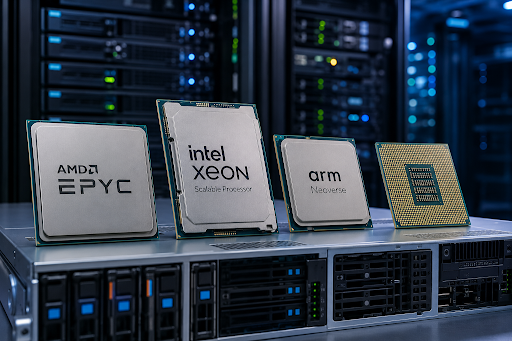
AMD EPYC Processors
AMD EPYC processors are broadly used in cloud data centers because of their high core counts, large cache capacities, and exceptional performance-per-dollar. They are specifically effective for virtualization, container hosting, and mass deployments, making them some of the best high-performance CPUs for cloud computing options.
Intel Xeon Scalable Processors
Intel Xeon Scalable CPUs are a popular option for enterprise cloud infrastructure. They offer strong ecosystem compatibility, enhanced security technologies, and dependable performance for critical cloud workloads. Due to their flexibility, they are also known as scalable processors for business systems that need continuous uptime and resource efficiency.
ARM-Based Cloud Processors
These emerging server processors include impressive power efficiency and scalability. These processors help cloud providers lower energy consumption while maintaining competitive performance. As demand for energy-efficient infrastructure expands, ARM CPUs continue to grow the market for cloud computing hardware CPUs across hyperscale data centers.
High-Performance CPUs for Enterprise Business Systems
Enterprise business systems need dependable processing power to support databases, virtualization, analytics, and crucial applications. Modern enterprise CPUS deliver scalability, security, efficiency, and constant performance for intensive business operations.
CPU Requirements for Enterprise Business Systems
High Core Count Architecture
Enterprise environments usually run multiple applications and virtual machines at the same time. Processors with higher core counts help organizations handle complex workloads without performance bottlenecks.
Large Memory Capacity
Business applications, like ERP, CRM, and database platforms, need substantial memory resources. Enterprise processors support large memory configurations to strengthen application responsiveness and data processing capabilities.
Enhanced Security Features
Modern enterprise processors incorporate hardware-based security technologies that aid in protecting sensitive business data from cyberattacks and unauthorized access.
Virtualization Support
Virtualization allows businesses to combine workloads and increase infrastructure utilization. Enterprise-level CPUs include technologies that enhance virtual machine performance and management.
Scalability and Reliability
Enterprise systems must support future expansion while maintaining uptime. Scalable processor architectures enable organizations to expand computing resources as business needs evolve.
Top CPUs for Enterprise Business Systems
AMD EPYC 9655
This CPU provides strong multi-core performance for enterprise databases, virtualization settings, and business-critical applications. Its large memory capacity and high I/O bandwidth make it one of the most capable server CPUs for virtualization in today’s enterprise infrastructure.
Intel Xeon Platinum 8592+
Built for demanding enterprise workloads, the Intel Xeon Platinum 8592+ processor provides improved security features, high memory support, and dependable performance for crucial business workloads.
AMD EPYC 9575F
The AMD EPYC 9575F processor provides high clock speeds that benefit enterprise applications requiring strong single-threaded performance, including financial software and transactional databases. It is also ideal for organizations deploying CPUs for data centers.
Intel Xeon 6766P
This processor balances performance and efficiency, making it suitable for virtualization clusters, enterprise resource planning systems, and large-scale business applications.
AMD EPYC 9535
Designed for enterprise data centers, the AMD EPYC 9535 processor provides scalable performance and resource efficiency for organizations managing a variety of business workloads.
Shop for the Best Next-Gen Processors for Cloud Computing and Enterprise Systems
Organizations seeking to upgrade infrastructure should assess processor availability, vendor support, and long-term scalability before making buying decisions. Businesses that buy processors in bulk typically gain pricing benefits and improved procurement flexibility.
- Procure processors from reliable enterprise hardware vendors.
- Compare pricing from several suppliers before purchasing.
- Verify manufacturer warranties and support coverage.
- Request big discounts for large infrastructure projects.
- Assess nationwide inventory availability and shipping options.
- Collaborate with experienced server hardware distributors.
- Review compatibility with current platforms and workloads.
- Give importance to suppliers providing technical consultation services.
Choosing Between Cloud Computing and Enterprise Business Systems for Next-Gen High-Performance Computing
Organizations must match processor investments with operational goals, workload needs, and strategies for expansion.
Choosing Cloud Computing
- Supports quick scalability and resource flexibility.
- Minimizes infrastructure management responsibilities.
- Allows on-demand provisioning of computing resources.
- Suitable for dynamic and distributed workloads.
- Helps organizations boost operational expenses.
Choosing Enterprise Business Systems
- Delivers increased control over infrastructure and data.
- Supports specialized business applications and compliance requirements.
- Allows customized performance optimization.
- Offers predictable resource distribution.
- Ideal for organizations and institutions needing dedicated environments.
Conclusion
Opting for the right processor is vital for achieving long-term performance, scalability, and efficiency. Whether supporting cloud platforms or enterprise applications, today’s central processing units deliver the computing power needed for demanding workloads.
Businesses should evaluate architecture, security features, memory capabilities, and workload needs before making an investment in new infrastructure.
As technology continues to evolve, next-gen enterprise central processing units will remain central to powering cloud services, virtualization settings, analytics platforms, and crucial business setups.
