
A countertop display has a simple job: put a product where people can see it, reach it, and understand what it is without taking up too much valuable
A countertop display has a simple job: put a product where people can see it, reach it, and understand what it is without taking up too much valuable counter space. That sounds straightforward, but getting the size right can be surprisingly important.
A display that is too small may hide products or make them difficult to pick up. A unit that is too large can crowd the counter and become an obstacle for customers or employees. The right dimensions depend on the products, the location, and the number of items you want to present.
So, what size is a countertop display usually?
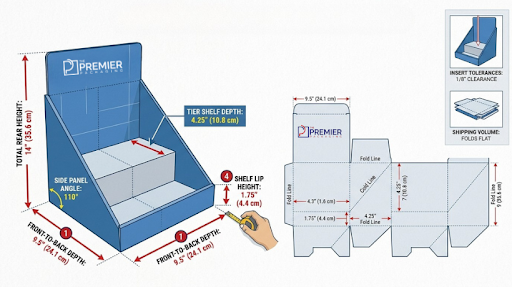
There isn’t one fixed measurement used for every retail display. In many cases, a practical countertop unit may be around 8 to 16 inches wide, 6 to 12 inches deep, and 10 to 18 inches high. These figures are useful starting points, but the final dimensions should be based on the actual products and the available counter space.
Why There Isn’t One Standard Size
Retail products come in too many shapes and sizes for a single display measurement to work everywhere.
Think about a small cosmetic product, a packaged snack, a bottle, and a set of accessories. Each requires a different amount of space. A display designed for small impulse-buy products might only need a few inches of depth, while a unit holding boxed merchandise may require a larger base.
The location also changes the equation.
A display sitting beside a cash register has different requirements from one placed on a wide reception counter. Near a checkout area, every inch matters because customers and employees still need room to move, pay, and handle products.
For this reason, “standard dimensions” are better viewed as common size ranges rather than strict industry rules.
Typical Dimensions at a Glance
Here is a useful starting point for planning a countertop display:
| Display Size | Approx. Width | Approx. Depth | Approx. Height | Suitable For |
| Small | 6–10 inches | 4–8 inches | 8–12 inches | Small accessories and samples |
| Medium | 8–16 inches | 6–12 inches | 10–18 inches | Everyday retail products |
| Large | 14–24 inches | 10–16 inches | 18–30 inches | Multiple products or larger ranges |
These measurements aren’t a requirement. They simply show how countertop displays are commonly scaled.
The important thing is to avoid choosing dimensions just because a particular size is described as “standard.” Measure the products and the counter first.
Start With the Products
The products should determine the display’s basic structure.
Measure the width, depth, and height of the items you plan to put inside it. Then decide how many products should be visible at one time.
Suppose you are displaying six small boxes. You may want three products across the front and three behind them. If customers need to reach the back row, the depth should allow easy access without obscuring the front products.
You also need to think about restocking. A display that fits the products perfectly but leaves no room for staff to replace them can become frustrating to use.
Leaving a small amount of extra space usually makes the display more practical.
How Wide Should a Countertop Display Be?
Width mainly depends on how many products you want to show side by side.
A narrow display can work particularly well when the purpose is to highlight one product or a small collection. It can also be useful when counter space is restricted.
A wider unit makes sense when several product varieties need to be shown together. For example, a retailer selling different flavors, colors, or sizes may want enough horizontal space for customers to compare the options.
Don’t make the display wider simply to fill available space. Empty areas can make a product presentation look unfinished, while an overcrowded display can make products difficult to distinguish.
The goal is a balanced arrangement where every item has enough room to be noticed.
Getting the Depth Right
Depth is easy to overlook, especially when attention is focused on width and height.
A deep display can hold more products, but it also occupies more counter space. In a busy store, that can become a problem.
Consider everything around the display. Is there a payment terminal nearby? Does a cashier need to reach across the counter? Will customers stand directly in front of it? Could a deeper unit block another product?
These questions can influence the ideal footprint.
For smaller merchandise, a relatively shallow display is often enough. Larger products may require additional depth, but the structure should still be proportionate to the counter.
What About Height?
Height affects visibility.
If a display is very short, products may get lost among other objects on the counter. Increasing the height can make the display easier to notice, particularly when it includes several product levels.
But taller isn’t automatically better.
A display that rises too high can block signs, merchandise, or the customer’s view across the counter. It can also make the unit feel oversized compared with the products it holds.
For many applications, somewhere around 10 to 18 inches high is a useful starting point. Multi-level displays can be taller when the additional vertical space genuinely improves product visibility.
Counter Space Should Influence the Design
Before finalizing dimensions, measure the actual area where the display will sit.
Don’t measure only the countertop itself. Look at the surrounding space too.
For example, a retailer might have a 24-inch-wide section available, but placing a 20-inch-wide display there may leave almost no room for anything else. A slightly smaller unit could provide a cleaner presentation and make the counter easier to use.
It is usually better to have a display that fits naturally into its environment than one that uses every available inch.
Product Visibility Matters More Than Maximum Capacity
A common mistake is trying to fit as many products as possible into one display.
More products don’t necessarily mean better presentation.
If items are packed tightly together, customers may struggle to see individual products or read their labels. A display with fewer products, arranged clearly, can attract more attention.
Think about what the customer sees from several feet away. Is the main product easy to recognize? Is the brand visible? Can someone quickly understand what is being offered?
Good dimensions should support those answers.
Choosing the Right Material
The material also influences the structure and size of a display. Paperboard and cardboard are popular choices for temporary retail promotions, product launches, events, and point-of-purchase marketing because they can be printed and shaped into various forms.
For businesses looking for a lightweight option, a cardboard counter display box can be customized with shelves, pockets, dividers, header panels, or product slots.
Material thickness matters as well. A display holding lightweight items may not need the same construction as one carrying heavier products. The base and supporting sections should be strong enough for the intended load.
Branding Shouldn’t Take Away from the Product
A countertop display is also a small advertising space.
The front, sides, and header can carry a logo, product name, short message, or other visual information. But branding needs to be balanced with product visibility.
Too much text can make a small display look cluttered. In most cases, a clear product message and recognizable branding are more effective than filling every available surface.
This is where custom packaging design can make a difference. The Premier Packaging can help businesses consider the display structure, product arrangement, and printed presentation as parts of the same design rather than treating them separately.
When Should You Consider Custom Dimensions?
Custom sizing is worth considering when your products don’t fit comfortably into common display ranges.
It can be especially useful when:
- Products have unusual shapes or dimensions
- Several product sizes need to be displayed together
- Counter space is unusually narrow
- A specific number of products must fit into each row
- The display needs shelves or individual compartments
- Branding requires a particular header size
- The unit will be used in a specific retail environment
A custom design doesn’t necessarily mean making the display complicated. Sometimes it simply means adjusting the width, depth, or height by a few inches so the unit works better.
Final Words
Before approving a countertop display, take a few measurements and consider how it will actually be used.
Measure the products, count the number of units you want visible, and check the available counter space. Think about customer reach, staff access, restocking, stability, and visibility.
Most importantly, don’t treat standard dimensions as a rule that your business has to follow. They are only a starting point.
A well-designed countertop display should feel like it belongs in the space. It should hold the products securely, make them easy to notice, and leave enough room for people to interact with the counter comfortably.
In many situations, a compact display in the 8–16-inch width range, with a depth of roughly 6–12 inches and a height of around 10–18 inches, will provide a useful starting point. From there, the dimensions can be adjusted according to the product and retail environment.
The best countertop display isn’t necessarily the biggest one or the one that holds the most merchandise. It’s the one that uses the available space intelligently and makes the products easier for customers to notice and explore.
