
In the current digital economy, the age verification system has emerged as a key compliance and risk management tool to the online operating business.
In the current digital economy, the age verification system has emerged as a key compliance and risk management tool to the online operating business. It may be online gambling, e-commerce, social media, gaming, or financial services, the companies have to make sure that minors have no access to age-restricted content, products, or services. Some of the regulatory bodies across the globe are increasing the level of compliance and online age verification has become not only an option, but a legal requirement.
With the emergence of digital fraud and the implementation of more stringent data protection regulations by regulators, the businesses have to implement safe, AI-driven age verification systems that would provide a balance between compliance, privacy, and user experience.
What Is an Age Verification System?
Age verification system is an online method that is utilized to ensure that the user is of the required legal age to access certain products, services, or content. In contrast to the straightforward self-declaration mechanisms, the modern system of verifying identities in the digital age is based on the sophisticated identity verification technology, such as biometric authentication, document security, and age prediction based on AI.
The systems assist organizations in meeting the child protection, online safety laws, anti-money laundering (AML) systems, and the know your customer (KYC) regulations.
Old techniques like tick-box confirmations are no longer viewed to be reliable. The modern compliance landscape requires real-time age verification, which is supported by an effective system of secure identity checks along with fraud prevention tools.
The Importance of Age Checking to Businesses
The compliance of age verification is mandatory in various industries. Online gambling sites should ensure that the clients are of the required age to gamble. The retailers of alcohol and tobacco should prevent the underage sales. There is increased government scrutiny on the use of social media in access by minors. Even websites that offer streaming services and other gaming organizations are to introduce age verification procedures to adhere to digital safety measures.
Lack of an appropriate age verification system may result in regulatory fines, reputation loss and legal claims. The data protection offices of most jurisdictions demand businesses to show that they have powerful age verification procedures.
Besides, installing an identity and age verification system would help in fraud prevention. Minors are becoming more and more involved in using fake identities and artificial identities in order to pass through loosely enforced age verification. The systems based on AI identify the cases of document tampering, spoofing, and biometric manipulation, providing a better degree of security.
The Process of an Online Age Verification System
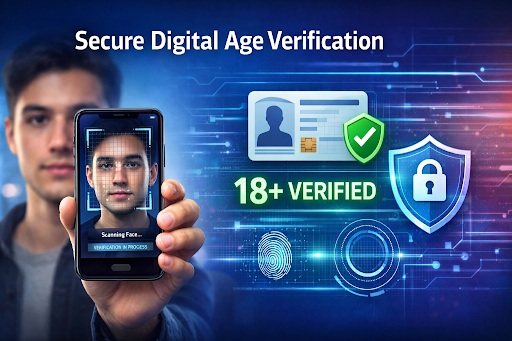
The current age verification system on the internet works in several levels of identity verification. It typically starts with the process of user onboarding during which customers will provide government-provided identification documents, passports or driver licenses.
State-of-the-art age verification is a software that combines liveness to thwart spoofing attempts by photo or deepfakes. The system checks the genuine physical presence of the user when he is being verified.
Other companies introduce age gating controls together with KYC verification to permit the regulatory checks and greater due diligence. This multi-layered scheme enhances the process of identity verification as well as age validation.
The Major Characteristics of an Effective Age Verification Solution
A good age verification system must provide automated age checks, biometric checks, real time verification reports, and compliance ready reporting. Scalability is as well of the essence particularly to global companies that are located in various jurisdictions.
The focus of privacy of information has to stay at the center. The current solutions have encrypted data transmission and adhere to international privacy laws like GDPR and other data protection standards. Age verification technologies that preserve privacy are becoming popular and the businesses can verify age without having too much personal information stored about them.
The industries that need age verification systems are industries that involve minors
The need of digital age verification systems is fast growing in all industries. The age checks must be quite stringent on online gambling and betting platforms to ensure they are in line with the regulatory authorities. Any e-commerce sites that sell a restricted product like alcohol, vaping product, or adult content should carry out an effective age verification process.
Gaming is also being pressured to make sure that people are of the right age, especially in regards to in-game purchases and online communication. Social media companies are supposed to provide safety of children online especially in those countries where strict regulations of online services are enforced.
Banks providing youth banking services are required to authenticate age in line with the KYC and AML requirements. Age verification tools based on identities are also taking root in cryptocurrency platforms that tend to be popular among the younger generations.
Regulatory Environment and Compliance Mandates
Stronger age verification compliance frameworks are being put in place by the governments around the world. The data protection agencies stress that the safety of minors against harmful online content should be considered. Refutable, safe methods of assuring age have to be adopted by business instead of self-attestations.
The digital service providers in a number of jurisdictions are required to carry out risk assessments, and introduce reasonable age verification controls. Failure to comply would attract hefty fines, suing, and limitation of operations.
The issue of age verification also overlaps with the compliance of the AML and the need of customer due diligence. The companies should make sure that the identity verification service should identify fraudulent identities and still secure their data.
AI and Future of Age Verification Technology
The technology of age verification is changing with the artificial intelligence. The age estimation technologies developed on the basis of AI run deep-learning algorithms to evaluate facial features and determine age with high precision. This makes the process of onboarding less frictional and improves user experience.
Liveness and biometric age verification minimise identity fraud. The algorithms of machine learning are constantly improved to adapt to emerging trends in fraud, which will enhance the system with time.
There is also the focus on privacy-enhancing technologies. Zero-knowledge proofing schemes permit age verification without the disclosure of full identity information, which will help mitigate the issue of data minimization and data privacy.
With the growing digital ecosystems relying on virtual space and the metaverse, the issue of age verification will become even more urgent to secure online space.
Selecting the Age Verification System
To choose the appropriate age verification system, the attention of compliance needs, geographic coverage, fraud risks, and integrating features must be carefully paid. The main focus of businesses should be on solutions with document verification and biometric authentication, AI-driven fraud detection, and regulation reporting capabilities.
It is necessary to have scalability to expand businesses. The global ID coverage and multilingual verification procedures are guaranteed by the solution, which guarantees an easier international expansion.
Conclusion
Age verification system is not a mere compliance solution anymore; it is a strategic requirement of digital businesses that are in the regulated sectors. Due to the increasing governments restricting child protection regulations and software safety, businesses need to implement secure AI-based solutions to age verification that meet compliance, fraud prevention, and privacy protection.
Modern systems offer powerful protection against access by underage or identity fraud with the assistance of biometric age checks, document verification, and AI-powered age estimation. Not only are businesses required to comply with the regulations, but also invest in highly developed technology that enables securing of the digital age verification, building trust, keeping the reputation intact and enhancing the long-term resiliency of the business operations.
