
Applying for a Civil Service job can feel exciting, but it can also be a little intimidating. You polish your CV, tailor your personal statement, and
Applying for a Civil Service job can feel exciting, but it can also be a little intimidating. You polish your CV, tailor your personal statement, and then you come across something called civil service behaviours. If you’re new to the recruitment process, it’s easy to wonder what they actually mean and why they’re such a big deal.
The truth is, behaviours are one of the most important parts of the UK Civil Service Success Profiles framework. They’re designed to help recruiters understand how you work, not just what you’ve achieved. Two candidates may have similar qualifications, but the one who consistently demonstrates the right behaviours is often better prepared for the role.
Whether you’re applying for an entry-level position or aiming for a senior leadership role, understanding these behaviours can make a significant difference. Once you know what hiring managers are looking for, it becomes much easier to write stronger applications and answer interview questions with confidence.
What Are Civil Service Behaviours?
Civil Service Behaviours are specific actions, attitudes, and ways of working that contribute to effective performance across the UK Civil Service. Rather than focusing only on technical expertise or academic qualifications, they measure how candidates approach challenges, communicate with others, solve problems, and deliver results.
These behaviours form one part of the Success Profiles recruitment framework, which is used to assess applicants fairly and consistently across many government departments.
Instead of asking broad questions like “Are you a good leader?” recruiters look for evidence of real situations where you’ve demonstrated key workplace behaviours. This evidence often comes from previous employment, voluntary work, education, apprenticeships, or even personal projects.
The emphasis is on practical examples that show how you think, act, collaborate, and make decisions in real-life situations.
Understanding the Success Profiles Framework
Before focusing solely on behaviours, it’s helpful to understand the bigger picture.
Success Profiles is the Civil Service recruitment framework used to assess candidates through several different elements depending on the role. These elements allow employers to evaluate applicants more holistically rather than relying on qualifications alone.
Common Success Profile elements include:
- Behaviours
- Strengths
- Ability
- Experience
- Technical skills
- Professional qualifications
Not every vacancy assesses every element. Some positions may focus primarily on behaviours and strengths, while specialist roles often include technical assessments and professional knowledge.
Because behaviours appear so frequently across recruitment campaigns, many candidates spend the majority of their preparation learning how to present strong behavioural examples during both applications and interviews.
Understanding how behaviours fit within Success Profiles helps applicants prepare more strategically instead of treating each stage as an isolated assessment.
Why Civil Service Behaviours Are So Important
Imagine two applicants with almost identical work histories.
One simply lists responsibilities on their application. The other explains how they solved problems, worked with colleagues, adapted during change, and achieved measurable results.
Which candidate leaves the stronger impression?
That’s exactly why behaviours matter.
The Civil Service isn’t just recruiting people who can complete tasks. It wants individuals who can communicate effectively, manage competing priorities, demonstrate integrity, make sound decisions, and contribute positively to public service.
Behaviour-based assessments also provide a more consistent way of comparing candidates from different industries and educational backgrounds. Whether your experience comes from retail, healthcare, education, customer service, or the private sector, you can still demonstrate behaviours that transfer successfully into Civil Service roles.
Strong behavioural evidence often highlights qualities that aren’t immediately visible on a traditional CV.
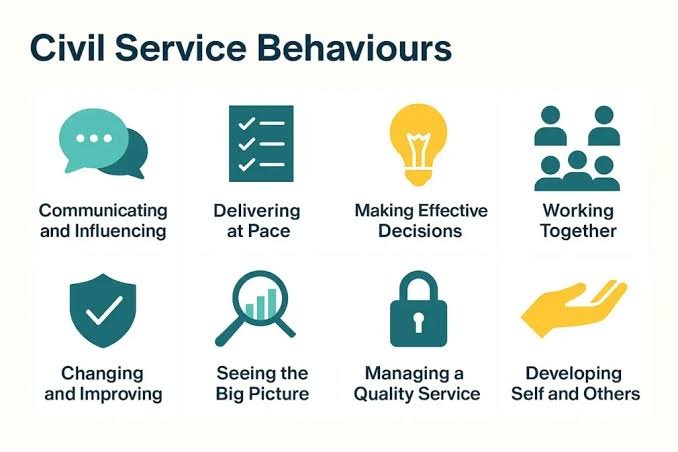
The Most Common Civil Service Behaviours
Although specific requirements vary depending on grade and department, several behaviours appear regularly across Civil Service recruitment.
Some of the most frequently assessed behaviours include:
Seeing the Big Picture
Understanding how your work contributes to wider organisational goals and public outcomes.
Changing and Improving
Showing a willingness to learn, adapt, solve problems, and embrace better ways of working.
Making Effective Decisions
Gathering relevant information, analysing evidence, and making balanced, informed choices.
Leadership
Supporting, motivating, and guiding others while promoting collaboration and accountability.
Communicating and Influencing
Sharing information clearly, listening actively, and adapting communication to different audiences.
Working Together
Building positive relationships, respecting diverse perspectives, and collaborating effectively across teams.
Delivering at Pace
Managing workloads, prioritising tasks, meeting deadlines, and maintaining quality under pressure.
Each behaviour reflects practical workplace expectations rather than abstract personality traits.
How Civil Service Behaviours Are Assessed
Many applicants assume behaviours are only evaluated during interviews, but they’re assessed throughout the recruitment process.
You may be asked to demonstrate behaviours through:
- Behaviour-based application questions
- Personal statements
- CV examples
- Online assessments
- Video interviews
- Panel interviews
- Assessment centres
Interview questions often begin with prompts such as:
- “Tell us about a time when…”
- “Describe a situation where…”
- “Give an example of…”
These questions encourage candidates to provide structured examples rather than hypothetical answers.
Recruiters are generally looking for clear evidence of your actions, decision-making process, and the outcomes you achieved, not simply descriptions of your job responsibilities.
Preparing several adaptable examples before applying can make every stage of the recruitment process much less stressful.
Using the STAR Method to Answer Behaviour Questions
One of the best ways to demonstrate civil service behaviours is by using the STAR method. Recruiters often recommend this approach because it helps candidates present clear, structured, and evidence-based answers rather than jumping between unrelated details.
STAR stands for:
- Situation – Briefly explain the context.
- Task – Describe your responsibility or objective.
- Action – Explain exactly what you did. This is the most important part of your answer.
- Result – Share the outcome, ideally with measurable results or lessons learned.
For example, instead of saying, “I worked well in a team,” describe a real project where your collaboration helped solve a problem or improve a process.
A strong STAR response is specific, concise, and focused on your personal contribution. Whenever possible, include achievements such as improved efficiency, positive feedback, cost savings, or successful project delivery to make your example more convincing.
Tips for Writing Strong Behaviour Statements
Writing behaviour statements can feel challenging at first, especially if you’re unsure how much detail to include. The key is to focus on evidence rather than general claims.
Here are a few practical tips:
- Choose examples that directly match the behaviour being assessed.
- Use “I” instead of “we” to highlight your individual contribution.
- Explain your decision-making process, not just the final result.
- Include measurable outcomes where possible.
- Keep your examples relevant to the role you’re applying for.
It’s also helpful to draw from a variety of experiences. Paid employment is valuable, but volunteering, education, internships, community projects, and leadership roles can also demonstrate strong behaviours.
Before submitting your application, read each behaviour statement again and ask yourself: Does this clearly show what I did, why I did it, and what happened because of my actions? If the answer is yes, you’re on the right track.
Common Mistakes Candidates Should Avoid
Even experienced professionals can weaken their applications by making a few avoidable mistakes.
One common issue is being too vague. Statements like “I’m a great communicator” or “I work well under pressure” don’t provide evidence. Recruiters want real examples that demonstrate these qualities in action.
Other mistakes include:
- Describing the team’s achievements without explaining your role.
- Using one generic example for every behaviour.
- Forgetting to explain the results.
- Writing long introductions with very little focus on actions.
- Ignoring the wording of the job advert.
Another frequent mistake is choosing examples that don’t match the behaviour being assessed. A great leadership story may not effectively demonstrate Making Effective Decisions if your actions and reasoning aren’t clearly explained.
Tailoring each example to the specific behaviour usually leads to stronger, more relevant responses.
How to Improve Your Behaviour Examples
Strong behaviour examples aren’t written in one sitting. They improve through review, refinement, and practice.
Start by identifying experiences from different parts of your life. Think about times when you solved a difficult problem, handled conflict, introduced a new idea, managed competing priorities, or supported others through change.
Once you’ve selected your examples, rewrite them using the STAR structure. Focus on clarity rather than complicated language. Recruiters are more interested in understanding your actions than reading impressive-sounding vocabulary.
Practising interview answers aloud can also make a noticeable difference. Speaking through your examples helps you identify areas that feel unclear or overly detailed.
Finally, ask a trusted colleague, mentor, or friend to review your responses. Fresh feedback often highlights opportunities to strengthen your examples before the interview.
Preparing for Civil Service Interviews
Behaviour-based interviews are often less about memorising perfect answers and more about demonstrating authentic experiences.
Before the interview:
- Read the job description carefully.
- Review the behaviours listed in the vacancy.
- Prepare two or three STAR examples for each key behaviour.
- Practise answering questions naturally rather than word for word.
- Be ready to explain your reasoning, not just your results.
During the interview, take a moment to think before answering. It’s perfectly acceptable to pause briefly and organise your thoughts.
Remember to focus on your own actions and contributions. Interviewers want to understand how you approached the situation, what decisions you made, and what impact those decisions had.
Confidence comes from preparation, not memorisation.
Final Thoughts on Civil Service Behaviours
Understanding civil service behaviours is about much more than passing an interview. These behaviours reflect the skills, attitudes, and actions that help people work effectively across the Civil Service and contribute to delivering high-quality public services.
By learning the Success Profiles framework, using the STAR method, and preparing clear, evidence-based examples, you can present your experience in a way that resonates with recruiters. Whether you’re applying for your first Civil Service role or looking to progress into a more senior position, investing time in developing strong behaviour examples is one of the smartest steps you can take.
Remember, recruiters aren’t looking for perfect candidates. They’re looking for people who can demonstrate how they’ve handled real situations, learned from challenges, and delivered meaningful results.
Frequently Asked Questions
1. What are Civil Service Behaviours?
Civil Service Behaviours are the actions and ways of working that contribute to effective performance in the UK Civil Service. They form part of the Success Profiles recruitment framework used to assess job applicants.
2. How many Civil Service Behaviours are there?
The Success Profiles framework includes several core behaviours, such as Seeing the Big Picture, Changing and Improving, Making Effective Decisions, Leadership, Communicating and Influencing, Working Together, and Delivering at Pace. The behaviours assessed depend on the specific role.
3. What is the STAR method?
The STAR method is a structured way to answer behaviour-based questions. It stands for Situation, Task, Action, and Result, helping candidates present clear and relevant examples from their experience.
4. Can I use examples from university or volunteer work?
Yes. If your examples clearly demonstrate the required behaviour, experiences from education, volunteering, internships, or community activities can be just as valuable as paid employment.
5. How can I improve my Civil Service behaviour answers?
Review the job advert carefully, choose examples that match each behaviour, structure them using the STAR method, include measurable outcomes where possible, and practise delivering your answers confidently and naturally.
