
AI-powered coding tools have changed how quickly people can turn an idea into a working application. With a few prompts, it is now possible to generat
AI-powered coding tools have changed how quickly people can turn an idea into a working application. With a few prompts, it is now possible to generate interfaces, connect APIs, create database logic, and build functional prototypes without writing every line of code manually.
This approach, commonly known as vibe coding, can be extremely useful during the early stages of development. However, problems can appear when an AI-generated application becomes more complex. At this stage, it is important to recognize the signs your AI app needs a code audit, such as recurring bugs, inconsistent code, security concerns, performance issues, or difficulties adding new features.
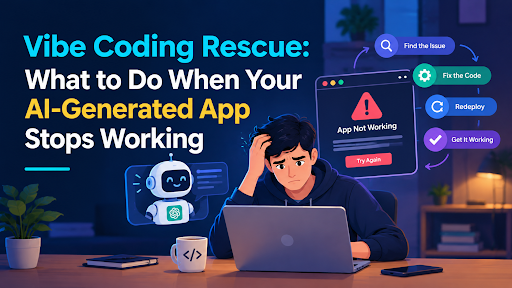
A feature that worked yesterday may suddenly stop working. Fixing one bug may create another. Authentication may behave unexpectedly, database queries may fail, integrations may break, or the application may become increasingly difficult to understand.
This is where Vibe Coding Rescue becomes important.
What Is Vibe Coding Rescue?
Vibe Coding Rescue is the process of taking an existing AI-generated or AI-assisted application, understanding how it works, identifying its problems, and bringing it back to a stable and maintainable state.
It is different from building an application from scratch.
When developing a new application, developers can establish the architecture, coding standards, database structure, security practices, and testing strategy from the beginning. With an existing AI-generated application, those decisions may already be embedded in the codebase—sometimes inconsistently.
The first task is therefore not simply to write more code. It is to understand the code that already exists.
Why Do AI-Generated Apps Break?
AI coding tools can generate impressive amounts of code quickly, but generated code still requires human review and testing. Recent research and industry reporting have highlighted concerns around security, maintainability, code review, and technical debt in AI-assisted Software development.
Several common problems can cause an AI-generated application to become unstable.
- Inconsistent Code
Different prompts may cause an AI tool to implement similar features in different ways. Over time, this can result in inconsistent patterns, duplicated logic, and difficult-to-maintain components.
- Quick Fixes Creating New Bugs
AI tools can sometimes solve the visible symptom without addressing the underlying problem. A developer may then encounter a chain of fixes where correcting one issue causes another.
- Missing Error Handling
Generated code may work correctly under normal conditions but fail when users provide unexpected input, an API becomes unavailable, or a database operation returns an error.
- Authentication and Security Problems
Authentication, authorization, database permissions, API keys, and input validation require careful implementation. Security weaknesses in AI-generated applications can be difficult to identify simply by looking at whether the application appears to work.
Security researchers and software engineering studies continue to emphasize the need for human review and systematic testing of AI-generated code.
- Growing Technical Debt
An application can accumulate technical debt when new functionality is continuously added without addressing underlying architectural and code-quality problems.
Eventually, the application may become harder to modify, test, and deploy.
Signs Your Vibe-Coded App Needs Rescue
Not every problem requires a complete rebuild. In many cases, the existing application can be stabilised through structured debugging and refactoring.
Some common warning signs include:
- Fixing one problem creates another.
- The same functionality exists in multiple places.
- Developers struggle to understand the generated code.
- API integrations frequently break.
- Database queries behave inconsistently.
- Authentication or permissions are unreliable.
- Deployment works differently from local development.
- New features take increasingly longer to implement.
- The application has little or no meaningful test coverage.
- Nobody is completely sure how important parts of the application work.
These symptoms can indicate that the project needs a systematic technical review rather than another quick AI-generated patch.
How to Rescue an AI-Generated Application
A successful rescue process should begin with understanding the existing system.
Step 1: Audit the Codebase
The first step is to examine the application’s architecture, dependencies, database structure, APIs, authentication, configuration, and major application flows.
The objective is to identify what is working, what is broken, and where the biggest risks are.
Step 2: Reproduce the Problems
Instead of immediately changing code, developers should reproduce reported issues and document the conditions under which they occur.
This helps distinguish between the actual root cause and the visible symptom.
Step 3: Identify Technical Debt
The next step is to locate duplicated logic, unnecessary dependencies, poorly structured components, fragile integrations, and other maintainability issues.
Not every imperfect piece of code needs to be rewritten. The focus should be on problems that create meaningful reliability, security, or development risks.
Step 4: Fix the Root Causes
Once the problems are understood, developers can address the underlying architecture or implementation instead of repeatedly applying temporary fixes.
This may involve refactoring components, restructuring database logic, correcting API integrations, improving error handling, or replacing problematic sections of generated code.
Step 5: Add Testing
Testing provides a safety net for future changes.
Depending on the application, this may include unit tests, integration tests, API tests, end-to-end tests, security testing, and regression testing.
Step 6: Review Security
Authentication, authorization, secrets, database permissions, input validation, dependencies, APIs, and exposed endpoints should be reviewed before the application is considered production-ready.
Step 7: Establish a Maintainable Development Process
Once the application is stable, future AI-assisted development should follow clearer rules.
Developers can use AI for productivity while maintaining human ownership of architecture, code review, testing, security, and important technical decisions.
Rescue or Rebuild?
One of the most important questions is whether an existing application should be repaired or rebuilt.
A rescue may make sense when the application’s core architecture is sound and the problems are limited to specific areas.
A rebuild may be considered when fundamental architectural decisions are flawed, critical functionality is unreliable, security problems are deeply embedded, or maintaining the existing code would require disproportionate effort.
The decision should be based on a technical assessment rather than simply assuming that AI-generated code needs to be discarded.
The Role of Developers in the Vibe Coding Era
Vibe coding does not eliminate the need for software engineering. Instead, it changes where developers spend their time.
AI can help generate code, but developers still need to understand architecture, requirements, security, testing, performance, integrations, and long-term maintainability.
A recent 2026 survey of software professionals found that teams widely report productivity improvements from AI coding assistants, while also reporting significant workflow issues involving manual review, security testing, and code rework.
That makes the ability to read, evaluate, debug, and improve AI-generated code increasingly valuable.
Final Thoughts
AI-assisted development can dramatically shorten the distance between an idea and a working prototype. But getting an application to work is only one stage of software development.
When an AI-generated application starts accumulating bugs, inconsistent code, security concerns, or technical debt, repeatedly asking an AI tool for another fix may not solve the underlying problem.
Vibe Coding Rescue provides a different approach: understand the existing codebase, identify the root causes, repair the critical issues, improve reliability and security, and establish a foundation that can be maintained as the application grows.
The goal isn’t to eliminate AI-generated code. It’s to make sure that the code generated with AI can ultimately become software that people can understand, maintain, test, and trust.
