
Choosing furniture should be exciting. Yet few things kill that excitement faster than watching a delivery team discover that your beautiful new sofa
Choosing furniture should be exciting. Yet few things kill that excitement faster than watching a delivery team discover that your beautiful new sofa cannot turn through the hallway.
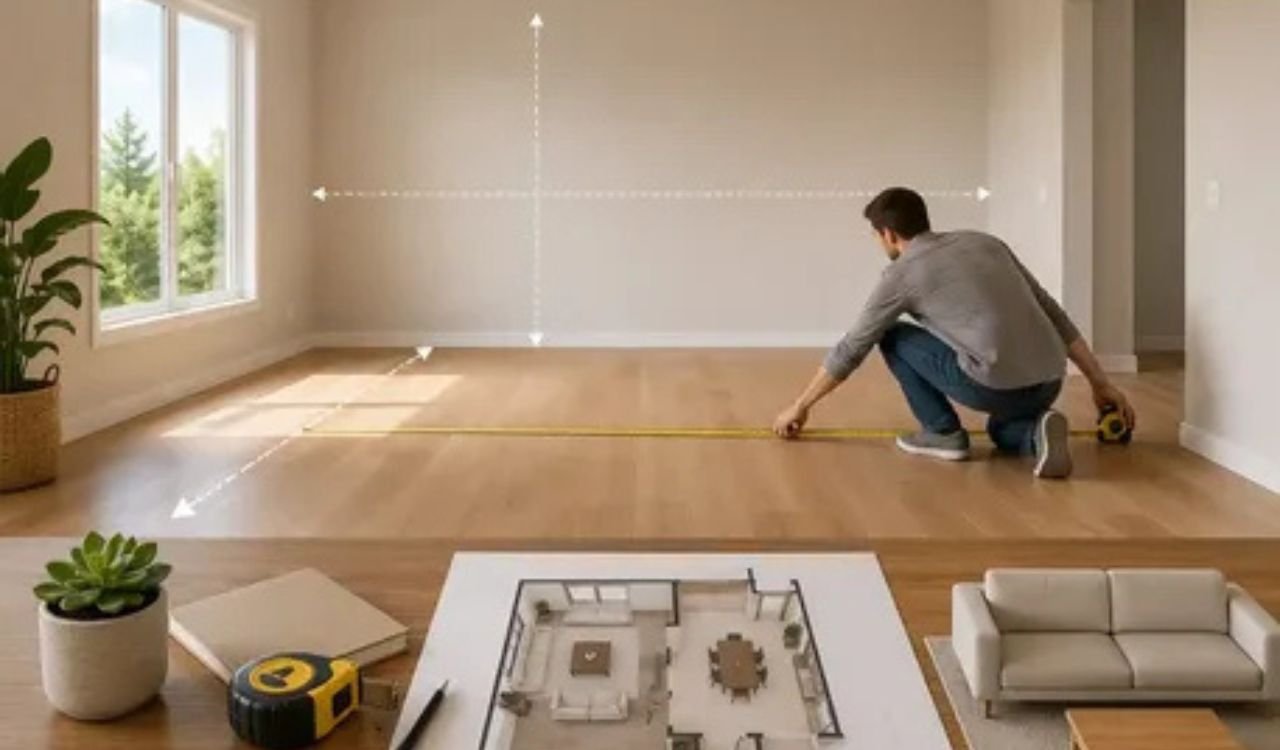
Learning how to measure a room for furniture is not difficult, but it requires more than stretching a tape measure across two walls. You need the room’s length, width, and height, plus the position of doors, windows, outlets, vents, radiators, and built-ins. You also need to check the entire delivery route and leave enough open space to walk comfortably.
Start With the Right Measuring Tools
You do not need professional drafting equipment to measure a room accurately. A sturdy tape measure, pencil, notebook, graph paper, and phone camera will handle most jobs. A laser measure is helpful in large rooms or when you are working alone, but it is smart to verify important readings with a standard tape measure.
Choose one unit—feet and inches, inches only, or centimeters—and use it throughout your notes. Mixing units is an easy way to turn a sensible floor plan into accidental dollhouse furniture.
Give every wall a letter, such as Wall A, B, C, and D. Take photos from each corner and photograph unusual details. Those images will help later when you cannot remember whether the outlet was beside the window or hidden behind the door.
Measure the Room’s Length, Width, and Height
To understand how to measure a room for furniture, begin with the largest wall-to-wall dimensions. Measure the room’s length and width at floor level, then record the ceiling height. Do not assume opposite walls are identical. Older houses, extensions, bay windows, and slightly uneven construction can create small but important differences.
Measure every wall separately from finished surface to finished surface. Include baseboards or skirting boards when a piece must sit tightly against the wall. For built-in furniture, wardrobes, or bookcases, take measurements at the bottom, middle, and top because walls are not always perfectly straight.
Finally, measure diagonally from one corner to the opposite corner. If the two diagonal measurements differ noticeably, the room may not be square. That does not ruin your layout. It simply means you should plan with the smallest usable measurement instead of the most optimistic one.
Map Doors, Windows, and Fixed Features
A room is not an empty rectangle. Doors swing, windows need light, vents require airflow, and electrical outlets somehow end up exactly where you planned to place the bookcase.
Work clockwise around the room. Measure from one corner to the first architectural feature. Then measure the full width of that feature—including its trim or casing—and continue to the next feature.
Mark all of the following on your sketch:
- Doors and door swings
- Windows and window trim
- Fireplaces and columns
- Alcoves and built-in cabinets
- Radiators and air vents
- Outlets and light switches
- Air-conditioning units
- Floor vents and heating registers
For windows, record the sill height and the distance between the top of the window and the ceiling. Tall furniture also requires measurements around beams, sloped ceilings, cornices, and hanging lights.
Check the Entire Furniture Delivery Route
A sofa that fits inside the living room is useless if it cannot reach the living room. Before ordering, walk along the same route the delivery team will use and measure every possible restriction.
Check the front door, porch, security gate, interior doors, hallway width, staircase, ceiling height, landings, corners, elevator entrance, and elevator interior. Record the narrowest point and watch for handles, railings, light fixtures, low ceilings, or sharp turns.
Then compare those measurements with the furniture’s packaged dimensions—not only its assembled size. Ask the retailer whether the legs, cushions, doors, arms, or back can be removed.
For awkward items, diagonal depth can determine whether the furniture can rotate through an entrance. When the measurements are close, send the retailer your delivery-route dimensions before paying. “It should probably fit” is not much of a delivery strategy.
Measure the Furniture and Plan Comfortable Clearances
Furniture dimensions are normally listed as width, depth, and height. Check all three. People frequently focus on width, only to discover that a deep sofa consumes the walkway or a tall wardrobe collides with decorative molding.
As a practical planning target, leave approximately 30 to 36 inches for the room’s main walking paths. Around 14 to 18 inches between a sofa and coffee table usually keeps the table reachable without trapping anyone’s knees.
Behind dining chairs, allow roughly 36 inches when possible so people can pull out their chairs and move behind them. You should also account for space beside beds, in front of drawers, and behind reclining furniture.
These are useful planning guidelines rather than magical numbers. A compact room may require sensible compromises. What matters is testing how people will enter, sit down, open doors, access storage, and move through the room.
Draw a Floor Plan and Test It With Painter’s Tape
Once your measurements are recorded, turn them into a basic floor plan. You can use graph paper or a digital room-planning application. A convenient hand-drawn scale might be one square for every six inches or one square for every foot, depending on the room and your paper size.
Draw the walls first. Add doors, door swings, windows, and permanent features. You can then create scaled paper rectangles for each piece of furniture and move them around without redrawing the entire room.
Next, transfer your preferred layout to the floor using painter’s tape. Outline the sofa, bed, dining table, or sectional at its actual dimensions.
Walk around the taped area. Open nearby doors, pull out dining chairs, and imagine the drawers extending into the aisle. A furniture outline that looked harmless on a screen can suddenly feel enormous when it occupies your real floor.
Handle Irregular Rooms and Avoid Common Mistakes
Irregular spaces need more measurements—not more guesswork. Divide an L-shaped room into smaller rectangles and measure each section separately. For bay windows, angled walls, niches, or curved areas, mark multiple reference points and record the shortest usable depth.
One common mistake is taking a single overall measurement and assuming the rest of the room matches it. Another is measuring from the trim on one wall but from the plaster on another.
People also forget to account for:
- Door swing clearance
- Radiator airflow
- Open drawers and cabinet doors
- Reclining furniture depth
- Window treatments
- Baseboard thickness
- Floor-level outlets
- Furniture overhangs and handles
Write down each dimension immediately and label it clearly. Never trust your memory after measuring several walls; the numbers quickly begin to resemble a particularly boring lottery ticket.
Measure every critical area twice. For custom or non-returnable furniture, ask another person to repeat the measurements independently.
A Common Delivery-Day Scenario
Imagine someone ordering a generously sized armchair for a small upstairs bedroom. On paper, the chair fits beautifully. There is room beside the bed, the wardrobe can open, and the main walkway remains comfortable.
Then the delivery day arrives. The armchair clears the front entrance and reaches the top of the stairs, but its rigid back cannot rotate around the narrow landing. After a heroic amount of tilting—and probably a few creative words—the chair has to go back downstairs.
The lesson is simple: learning how to measure a room for furniture includes measuring the journey, not only the destination. Doorways, staircases, elevators, hallways, and corners are part of your furniture plan.
A piece must fit the room, of course. First, however, it must survive the trip there.
Use This Final Room-Measuring Checklist
Before purchasing furniture, confirm that you have recorded the room’s length, width, ceiling height, individual wall lengths, and any diagonal or irregular areas.
Mark every door, window, outlet, vent, radiator, fireplace, built-in feature, and other permanent obstruction. Then inspect the delivery path from the outside entrance to the furniture’s final position.
Compare the narrowest opening with both the assembled and packaged furniture dimensions. Add the item to a scaled floor plan, allow enough room for normal movement, and test large pieces with painter’s tape.
Take one final look at how the space functions:
- Can every door open fully?
- Can dining chairs slide backward?
- Can drawers extend completely?
- Is there room for a recliner to operate?
- Can someone walk across the room comfortably?
That is how to measure a room for furniture confidently: measure the shell, map the obstacles, test the layout, and verify everything before ordering.
Frequently Asked Questions
What is the easiest way to measure a room for furniture?
Measure every wall and record the room’s length, width, and height. Sketch the results, then add doors, windows, fixed features, and furniture clearances. A tape measure and graph paper are enough for most rooms, although a laser measure can make larger spaces easier.
Should I measure the room in feet or inches?
Either system works, but consistency is essential. Inches are often convenient when comparing exact product specifications. When using feet and inches, write both clearly and do not switch to centimeters halfway through your notes.
How much walking space should I leave between furniture pieces?
Aim for approximately 30 to 36 inches along main walking routes when the room allows it. Smaller gaps may work in tight spaces, but test them with painter’s tape and confirm that doors, drawers, chairs, and reclining furniture can operate properly.
How do I know whether a sofa will fit through a doorway?
Compare the entire delivery route with the sofa’s height, width, depth, diagonal depth, and packaged dimensions. Ask whether its legs or back can be removed. Check every hallway turn, staircase landing, doorway, gate, and elevator—not only the room entrance.
Do room-planning apps replace manual measurements?
No. Planning apps are useful for testing layouts and visualizing scale, but their results are only as accurate as the numbers entered. Verify critical dimensions manually, especially when purchasing custom furniture, planning a tight layout, or dealing with a complicated delivery route.
